Search This Blog

Wednesday, May 7, 2025

5/7/2025

 Wednesday, May 7, 2025

D+182/107

1824 Beethoven's 9th (Choral) Symphony premier in Vienna, Austria

1945 Unconditional surrender of the German Third Reich to the Allies was signed by General Alfred Jodl at Reims in northern France

1975 US President Gerald Ford declared an end to the "Vietnam Era."

1984 $180m out-of-court settlement was reached in the Agent Orange suit

2020 Father and son were arrested for the murder of Ahmaud Arbery in Brunswick, Georgia, after video of the killing surfaced

In bed at 9:40 after LO'D monologue, up at 5:40, 48°, high of 54°, windy again.

Prednisone, day 358; 2 mg., day 20/21; Kevzara, 9/14; CGM, day 5/15; Trulicity.   Prednisone at 6:05 a.m.  Other meds at 6:20 a.m.  No empagliflozin today, tomorrow, and Friday.


Boor, lout, thug, brute, lummox, pig, moron, vulgarian, sadist, charlatan, rapist, conman, fraudster, fascist,  lowlife, liar, pagan, narcissistic, avaricious, and seditious,    What a wealth of words there is to describe the curent president of the United States of America.  I thought of what a vile, despicable human being he is as I watched his Oval Office Q and session with Mark Carney, the new prime minister of Canada, yesterday.  Trump has had the office redecorated with a lot of gold features on the walls and the fireplace.  He has given the room a cheesy, over-the-top, Mar-a-Lago look.  His former chief of staff, John Kelly, said of him: "The depths of his dishonesty just astounding to me. The dishonesty, the transactional nature of every relationship, though it’s more pathetic than anything else.  He is the most flawed person I have ever met in my life.”   He also called him "unhinged." Rex Tillerson, his first secretary of state, called him "a moron."  James Mattis, his first secretary of defense, said he has "the understanding of a fifth or sixth grader."  Other former high-ranking aides are reported to have called him "an idiot" and "like an 11-year-old."  But it's not so much his IQ that is a national embarrassment as it is his moral character and boorishness. his churlishness, his uncouthness, his classlessness and vulgarity, his lack of decency and respectability.  As I watched him seated next to Mark Carney yesterday, I envied the Canadians for having a political leader and head of state with class and dignity, unlike ours. 


It's getting harder to think.  I had a hard time understanding the discussion in this morning's NYTimes among Ross Douthat and two other conservative Catholics, Dan Hitchens (First Things) and Michael Brendan Dougherty (National Review), about the 'stakes' in the upcoming conclave to elect the next pope.  They toss around terms like modernity, liberalism, and progress as if they have meanings shared by all three of them.  I'm never sure exactly what these terms mean.  They appear to see "the grand scheme of things", like Western history and civilization, better than I do.  After reading their discussion, I read Dan Hitchens' essay on "The Last Modern Pope" in the Times, and I didn't do much better with that one either.  Part of my ineptitude must be my education, which didn't equip me to engage with guys like these, and part of it is old age and lack of energy to engage in close reading, maybe lack of interest, too.  A small part of it may also be my difficulty reading, which I hope will be helped by my cataract surgery on Friday.  I can't remember the last book I read cover to cover.  I get books, but only read parts of them.  The last books I read significant parts of were one on the writings of Yeshayahu Leibowitz on Judaism and the State of Israel, and Max Hastings's epic book on Vietnam.  I doubt that I will ever read another entire book.  I wonder often about cognitive decline, not whether I have any as I move toward my  84th birthday, but how much I am experiencing.  As the rest of my organs wear out, so does my brain.  I don't think I have dementia yet, at least none that is very noticeable, but my short-term memory and 'working memory' stink.   As I write this, I think of Zeke Emanuel's article in The  Atlantic, "Why I Hope to Die at 75."

Doubtless, death is a loss. It deprives us of experiences and milestones, of time spent with our spouse and children. In short, it deprives us of all the things we value.  But here is a simple truth that many of us seem to resist: living too long is also a loss. It renders many of us, if not disabled, then faltering and declining, a state that may not be worse than death but is nonetheless deprived. It robs us of our creativity and ability to contribute to work, society, the world. It transforms how people experience us, relate to us, and, most important, remember us. We are no longer remembered as vibrant and engaged but as feeble, ineffectual, even pathetic.

Neatnik or packrat?  I received a call from the ophthalmologist who will do my cataract surgery on Friday, asking what kind of lens was implanted when I had cataract surgery on my left eye about 10 years ago.  For many years, I had saved the package of stuff with which I was discharged from that surgery, probably including information that the doctor wanted.  Unfortunately, in a fit of 'getting organized' and ridding myself of stuff I had no use for, I threw it out about a year ago. The same fit of madness overcame me when we moved from Saukville to Bayside 14 years ago.  I gave away a ton of books I had been holding onto for many years, books that were worth keeping, but not worth packing and moving, or so I thought.  Since then, I have many times wished I had held onto this book or that, like, e.g., Constantine's Sword by James Carroll,  and The Arms of Krupp by William Manchester.  My natural tendency is to be a packrat, not a neatnik, but when the clutter gets to be too bad, I start throwing away stuff that I know I will eventually wish I had held onto.  So it goes.


Andy's family photo to ASC.  I ran it down to Shorewood this morning and had a very nice chat with Anne.  It was a bit of a jolt to see the fine furniture we had bought together at Paul Weise 40 or more years ago, still looking great, undiminished by age, unlike Anne and me.  

 The Oven Bird  BY ROBERT FROST

There is a singer everyone has heard,

Loud, a mid-summer and a mid-wood bird,

Who makes the solid tree trunks sound again.

He says that leaves are old and that for flowers

Mid-summer is to spring as one to ten.

He says the early petal-fall is past

When pear and cherry bloom went down in showers

On sunny days a moment overcast;

And comes that other fall we name the fall.

He says the highway dust is over all.

The bird would cease and be as other birds

But that he knows in singing not to sing.

The question that he frames in all but words

Is what to make of a diminished thing.


More from Zeke Emanuel's article, the stuff that makes me wonder about suicide:

[O]ver the past 50 years, health care hasn’t slowed the aging process so much as it has slowed the dying process. . . .  [T]he contemporary dying process has been elongated. Death usually results from the complications of chronic illness—heart disease, cancer, emphysema, stroke, Alzheimer’s, diabetes.

Take the example of stroke. The good news is that we have made major strides in reducing mortality from strokes. Between 2000 and 2010, the number of deaths from stroke declined by more than 20 percent. The bad news is that many of the roughly 6.8 million Americans who have survived a stroke suffer from paralysis or an inability to speak. And many of the estimated 13 million more Americans who have survived a “silent” stroke suffer from more-subtle brain dysfunction such as aberrations in thought processes, mood regulation, and cognitive functioning. Worse, it is projected that over the next 15 years there will be a 50 percent increase in the number of Americans suffering from stroke-induced disabilities. Unfortunately, the same phenomenon is repeated with many other diseases

So American immortals may live longer than their parents, but they are likely to be more incapacitated. Does that sound very desirable? Not to me.

The situation becomes of even greater concern when we confront the most dreadful of all possibilities: living with dementia and other acquired mental disabilities. Right now approximately 5 million Americans over 65 have Alzheimer’s; one in three Americans 85 and older has Alzheimer’s. And the prospect of that changing in the next few decades is not good. Numerous recent trials of drugs that were supposed to stall Alzheimer’s—much less reverse or prevent it—have failed so miserably that researchers are rethinking the whole disease paradigm that informed much of the research over the past few decades. Instead of predicting a cure in the foreseeable future, many are warning of a tsunami of dementia—a nearly 300 percent increase in the number of older Americans with dementia by 2050.

Half of people 80 and older with functional limitations. A third of people 85 and older with Alzheimer’s. That still leaves many, many elderly people who have escaped physical and mental disability. If we are among the lucky ones, then why stop at 75? Why not live as long as possible? 

Even if we aren’t demented, our mental functioning deteriorates as we grow older. Age-associated declines in mental-processing speed, working and long-term memory, and problem-solving are well established. Conversely, distractibility increases. We cannot focus and stay with a project as well as we could when we were young. As we move slower with age, we also think slower. 

I  think of that last paragraph in connection with my earlier entry about "It's getting harder to think."  I don't think it's what Emanuel calls "age-associated declines in mental processing speed," etc., that would cause me to end my life.  On the other hand, I think the fear of total or near-total incapacity and dependency from a devastating stroke, Parkinson's, or severe dementia, could.  I think of my grandmother in the nursing home in Port Charlotte until age 95, and of my Aunt Mary Healy in the nursing home in Phoenix, wanting to die and saying to God: "What's the matter?  I'm ready."  I think of the op-ed in the Times on  April16th, ""There’s a Lesson to Learn From Daniel Kahneman’s Death." about the assisted suicide of the man who chose to die at age 90 for the simple but sufficient reason that his life "was complete" and it was time to end it.  Serious thoughts, a serious subject.


Tuesday, May 6, 2025

5/6/2025

 Tuesday, May 6, 2025

D+181/106

2001 During a trip to Syria, Pope John Paul II became the first pope to enter a mosque

In bed at 9, up at 5, body all achin' an a-wracked wid pain.'  47°, high 67°.

Prednisone, day 357; 2 mg., day 19/21; Kevzara, day 8/14; CGM, day 4/15; Trulicity.  Prednisone at 5:20 a.m.  Other meds at 6:20 a.m.

Thoughts on the conclave, Conclave, faith, and the Faith.  Overall, I enjoyed the movie Conclave, especially the roles and the acting of Ralph Fiennes as Cardinal Lawrence and Stanley Tucci as Cardinal Bellini.  I enjoyed the depiction of fierce political infighting and what it suggested, to me at least, about the myth of the Holy Ghost guiding the process.  I enjoyed the depiction of high Church officials with scandals in their pasts.  I enjoyed the nearly smothering excess of tradition, history, and customs in everything from the uniforms worn by the prelates, the lesser clergy and religous, and the Swiss Guard, to the site of the deliberations in the Sistine Chapel, to the very word 'conclave,'  with its suggestions of secrecy, mystery, and exclusivity.  I enjoyed, though only in a perverse way, the Vatican's ubiquitous suggestions of royalty, a kingdom, and of Rome's imperium.  Mostly, however, I enjoyed the never-developed mention of Cardinal Lawrence's religious doubts about the Faith and the Church, the Holy Ghost guiding and presiding presence, and about God Himself.  Two thoughts came to mind.  The first was of the mainstream Protestant minister who was in the Marine Reserve unit I worked with in Philadelphia.  He told me he was an atheist and that many clergymen didn't believe in God, or at least in the conventional, traditional God believed in by most of the faithful.  The second was of my friend Tom St. John, a 'fallen-away' Catholic and Jewish convert, who picked me up after Mass one Sunday for a golfing outing.  When I got into his car, he asked me: "You don't really believe in all that shit, do you?"  I wrote that Cardinal Lawrence's dubeity was never developed as a theme in the movie, but perhaps it suffosed the entire plot, i.e., seeing how and through whom the papal selection process works, can anyone really believe that the whole process is somehow divinely-guided, or that it has anything to do with God, or with the relationship, if any, betwen God and humankind, 'made in his image.' Gen. 1:26-28. 1 Cor. 11:7.  Indeed, must we not wonder: if we are made in the image of God, what does that say about God?


The Prince of the Church in cardinal red is Raymond Burke, a native of Richland Center, Wisconsin, ordained a priest in LaCrosse, Wisconsin, where he served as its bishop before being promoted to Archbishop of St. Louis, and then again to the rank of cardinal in 2010 by Pope Benedict XVI.  He is a right-wing traditionalist, champion of the Latin Mass, and opponent of Pope Francis.  He is the biggest fop in the Vatican, as one might guess from the ridiculous length of the train of his robe he is wearing in this photo.  Until he was demoted by Pope Francis, he was the prefect of the Supreme Tribunal of the Apostolic Signatura, the highest judicial authority in the Catholic Church.  Francis also evicted him from his elegant, subsidized Vatican apartment.

From my memoir:

There is a story about Jesus in the gospels of Mark and Luke that receives too little attention from the professional Church, the priests and nuns and eminences with satin beanies and palatial residences.  Mark tells it like this:

People were bringing little children [or toddlers] to him in order that he might touch them; and the disciples spoke sternly to them.  But when Jesus saw this, he was indignant and said to them, “Let the little children come to me; do not stop them; for it is to such as these that the kingdom of God belongs.  Surely whoever does not receive the kingdom of God as a little child will never enter it.”  And he took them up in his arms, laid his hands on them, and blessed them.

Luke has the disciples even more authoritarian and off-putting than Mark: “when the disciples saw them, they sternly ordered them not to do it . . .”

It’s a great tale of Jesus’ warmth and physical affection – “he took them up in his arms . . .”   The aspect of the story that I am focusing on here, however, is that it is the disciples of Jesus, the ‘true believers,’ the ‘in crowd’ that stood between the children and Jesus.  It was the people closest to him who built a wall around him, attempting to fence Jesus in and fence the innocents out.  I reveal my hostility toward clericalism in admitting that I can’t help thinking of those disciples as the ecclesial ancestors of the Church’s clerical caste, the professional God-guys, or at least the pharisaical ones, of whom I have known a good many.

With our home life on the Good Ship Clausen so precarious and sometimes stormy, my mother’s stabilizing keel notwithstanding, the major influence on Kitty and me other than our family was the Catholic Church.  This influence was exercised mainly through parochial schooling at St. Leo’s Grammar School for both of us and Leo High School for me and Visitation High School for Kitty.  The grammar school was run by the Sisters of Providence headquartered outside Notre Dame, Indiana.  Leo was run by the Irish Christian Brothers and “Vis” by the Sinsinawa Dominicans with their motherhouse south of Platteville,  Wisconsin.  

As volatile as things could be at home, there was no visible volatility in the Holy, Roman, Catholic, and Apostolic Church, especially the Irish American version that ruled in Chicago and in St. Leo Parish.  The Church taught us that it was infallible, immutable, incorruptible and, in its view, specially commissioned by God Himself to lead us little children to Jesus.

The Clausen kids were religious citizens of the great Archdiocese of Chicago, an ecclesial jurisdiction that covered almost 1,500 square miles in Cook and Lake counties.  There were 4,200,000 people living in those counties in 1950 and 1,691,681 were officially Catholics, almost 40%, 80% of whom resided in the City of Chicago.  The diocese was divided into 393 parishes, 341 of which had parish elementary schools runs by nuns.   There were 75 Catholic high schools.   There were almost 1,200 diocesan priests and another 1,000 religious order priests, 1,000 religious order brothers, and about 8,000 sisters.  Running this vast operation was Samuel Cardinal Stritch who became archbishop of Chicago in 1940, promoted from his post as archbishop of Milwaukee.

Cardinal Stritch, like his predecessors and successors, lived in splendor in an elegant Victorian mansion at 1555 North State Parkway on the “Gold Coast” of Chicago.  The three story, 19 chimneyed mansion occupies a city block on the southern border of Lincoln Park and is probably the most valuable and desirable living quarters in the City of Chicago.  It is a dwelling fit for a feudal lord, which is what the Archbishop of Chicago was and is.    

In English feudalism after the Norman Conquest, all land was considered ultimately owned by the King.  The king distributed the land to vassals who promised always to render him loyalty, often to pay him money and other things of value, and usually to provide troops to him for his wars.  The top vassals, barons and earls, subdivided their tenures to subvassals who made similar promises of loyalty, rents, military service, or other ‘incidents of tenure’ in return for protection of their tenures by their immediate overlord.  From the king to the barons though layers of ‘subinfeudation’ down to the lowest freeholder there exisited a system of reciprocal rights and duties between lords and vassals.

This kind of system is still in play in the Catholic Church.  The Pope has the role of King or more aptly Emperor, the ultimate owner of the Church’s dominions and principalities (in trust for God, of course.)  He has his imperial court or curia.  He divides the imperium into geographical and jurisdictional dioceses (much as the Late Roman Empire was divided into dioceses) in which the usual vassal is the local ‘ordinary’ or bishop, who owes fealty, obedience and a share of his revenues from the diocesan holdings to the Pope in return for the Pope’s loyalty and protection (witness the Pope’s cushy treatment of Bernard Cardinal Law after his resignation in disgrace from the Boston archdiocese.)  The diocese in turn is subdivided geographically and jurisdictionally into parishes controlled by pastors who owe fealty, obedience and a share of the revenues from their parochial holding to the bishop in return for the bishop’s loyalty and protection (witness, as but one example, the bishops’ disgraceful protection of criminal priests in America, Ireland, Austria, and elsewhere.)  It is all very feudal, based on personal power and loyalty relationships between lords and vassals.  It is not mere tradition that causes the bishops to kneel before the Pope and kiss his ring or that calls for new priests and deacons to lie prostrate before their bishop during the Litany of Saints in the ordination liturgy in which they vow obedience to him, or that has the Pope addressed as “Your Holiness.” cardinals as “Your Eminence,” archbishops as “Your Grace,” and bishops as “My Lord.”  These practices and many more have their roots in the imperial courts of the Roman Empire and in European feudalism.  The Church’s feudal power structure was very much in force in the Chicago in which the Clausen children grew up.  Our parish priests were accountable to our pastor, our pastor was accountable only to the archbishop who was accountable only to the Vatican.

 How the Church operated internally, e.g., how it handled its finances and its personnel, was kept secret from the “laity,” a term whose only meaning is negative: those who are not priests.  How much money did the parishes provide to the archdiocese?  How much did the archdiocese provide to Rome?  How were bishops selected?  How were pastors and curates selected?  How were priests with alcohol or worse problems handled?  These were not matters for the ‘laity,’ but rather for ‘the Church,’ i.e., the priestly caste.  The Church was the clergy; the role of the laity was to pray, pay and obey.  As Pope Pius X wrote in his 1906 encyclical  Vehementer Nos.

It follows that the church is by essence an unequal society, that is, a society comprising two categories of persons, the pastors and the flock, those who occupy a rank in the different degrees of the hierarchy and the multitude of the faithful.  So distinct are these categories that with the pastoral body only rests the necessary right and authority for promoting the end  of the society and directing all its members toward that end; the one duty of the multitude is to allow themselves to be led, and, like a docile flock, to follow the pastors.


Monday, May 5, 2025

5/5/2025

 Monday, May 5, 2025

D+180/105

1916 US Marines invaded the Dominican Republic and stayed until 1924

1965 First large-scale US Army ground units arrived in South Vietnam

2022 WHO study of excess deaths worldwide said 15 million more people had died than normal, far above the official COVID-19 death toll of 6 million 

In bed at 9, awake and up at 4:30. 45°, high of 54°.  I lit a candle for Kitty. 

Prednisone, day 356; 2 mg., day 18/21; Kevzara, day 7/14; CGM, day 3/15;  Trulicity.   Prednisone at  5 a.m.  Other meds at 6 a.m.   

Anniversary thought.  I note that we call the Marines' operations in the Dominican Republic an "invasion" but never refer to our operations in Vietnam that way.  The governments in Saigon, first that of the Diems and then the successive military governments that followed them, were never really popularly elected.  Diem was an imperious, elite Catholic installed by the U.S. in a heavily Buddhist country.  He was a puppet, a bad puppet, but a puppet.  The military governments that overthrew and murdered him ruled by force of arms.  Diem, with the support of the U.S., cancelled the 1956 elections that were supposed to permit the reunification of the country after the 1954 Geneva Accords.  We cancelled them because it was a foregone conclusion that the popular Ho Chi Minh, Vietnam's George Washington, would win the election, which the U.S. couldn't tolerate.  When we landed the Marines at Danang in March 1965, it was an invasion, just like when the Marines invaded the D.R., and so I call it.


I received a text from Caela yesterday,
 while Geri was sitting shiva with Barb.   "Love you, Sweetie.  I know I'm not Tom, but I consider you a best friend.  So stick around awhile and keep me company."   Tom has been gone for more than 2 years now, and widowhood has been far from easy for Caela.  She stopped over on Saturday afternoon and visited for a couple of hours.   As we sat in the sunroom and chatted, I thought what a blessing it was to be together, talking, sharing, just being present to and with each other.  Very easy and enjoyable conversation.  I think she was responding to my statement Saturday that I experience some loneliness from having outlived so many best friends:  Kitty, Ed Felsenthal, Tom, and David Branch.   And of course, I have foolishly let other very good friendships evanesce, like Ara Cherchian and Vicki Conte.  Caela and I have been friends for about 50 years.


LTMW I finally see a goldfinch gathering nesting material from the big cotton ball.  If both the sparrows and the goldfinches use that cotton ball this season, I may have to get another one.  The crows are becoming more regular, in fact, too regular, visitors to the two suet cakes I have out there.  The goldfinches are also showing up more at the niger seed tube.  I think I need to empty the tube of the seeds, which are pretty weathered by now, and refill it with some fresh feed. 

FB posting this morning on a shared past:  I re-shared Herrick Goldman's sharing of an essay by Oliver Kornetske, who said he came from a small town in Wisconsin.

This is fine and thoughtful writing, better than I could do, but it seems pretty simplistic or reductionist in its description of "rural people."  The great Sarah Smarsh, who wrote "Heartland: A Memoir of Working Hard and Being Broke in the Richest Country on Earth," has been writing for years that farmers and other rural folks are not all stamped out from the same cookie cutter.  The election results show the same thing, as do the enormous crowds attending the Bernie Sanders/AOC rallies in Idaho and other deep red states.  Nonetheless, the writer is simply trying to make points about some and perhaps many rural voters, who often predominate, and it's hard to argue with them.  One of my pleasurable pastimes, one that I used to share with my Dad, is driving the country roads in the beautfiul farmlands of Ozaukee, Washington, and Sheboygan counties.  While I do so, I often think it's hard to imagine people living in these sparsely populated rural areas voting Democratic, for a party so identified with high taxes, high regulation, and domination by the interests of largely urban minority groups.  The lifestyles, cultures, employment patterns, and economic interests of rural vs. urban pleople can be pretty dissimilar, so it's not all that surprising that one group tends to vote one way and the other group the other way.  It's not helpful to look down our noses at the group of which we're not a member.  Also, I took special note of the writer's point that the vision many people have of the 1950s as a halcyon era in America is illusory.  Ditto for the late 1940s after World War II when America emerged victorious and the only land, people, and economy not devastated by the war.  We were at each other's throats in those days too, especially over the paranoid fear of communism and of the not-so-paranoid fear atomic warfare (Joe McCarthy, bomb shelters and fallout shelters, atomic bomb drills in schools.) 

I read the last "In Conversation" column in this morning's NYTimes.  For the last 8 years, the column has been a written conversation between liberal Gail Collins and conservative Bret Stephens.  It is always not just civil but friendly, because they are indeed friends despite their differing politics.  Collins lives on the Upper West Side of New York City, an area more densely populated than Gaza.  I don't know where Stephens lives, but he travels a lot and apparently does a lot of outdoorsy stuff.  It got me thinking again that the area in which we all live, work, and thrive has so much to do with our politics and our view of the world.  Urban dwellers know from their lived experiences that life is complex, complicated, involving a lot of dependencies and interdependencies, and the need for rules that help people of different backgrounds and cultures share the same spaces.  We must sacrifice some freedom and independence to live cheek-by-jowl with others.  When I lived in the rural Town of Saukville, I was free to have a fire pit in my backyard and to burn my copious autumn leaves.  I could - and did - erect a garden shed in my backyard without having to get a permit from the Town or the consent of my neighbors.  Life is different in suburban Baysidewhere I live now and even more different in urban Milwaukee, where I used to live - or in Gail Collins' Upper West Side of Manhattan.  These differences contribute mightily to differing political persuasions, or at least I think they do.  Those of us who are accustomed to living without much governmental involvement and interference in our lives, including by way of taxation,  like it that way and tend towards the Republican Party.  Those of us who live shoulder-to-shoulder with diverse others recognize the need for rule-making and for taxation to support public services; we tend to develop an accommodationist attitude toward life and government and to vote Democratic.  The toxins from the large piles of dead leaves that I would burn in my yard would blow into my neighbors' houses.  The eyesore garden shed I want to throw together in my backyard would interfere with my next-door neighbors' enjoyment of their backyard and probably diminish the marketability and value of their house.  Personally, my move to rural Ozaukee County didn't turn me into a Republican, but I grew up in Englewood on the south side of Chicago and have lived in urban-suburban areas most of my life.  I think I understand how folks who grew up in different circumstances couldn't imagine voting Democratic.  A big determinant of personal politics is whether one is a business owner and an employer, rather than an employee.  The older I get, the more I appreciate the challenges of the millions of fellow citizens who start and grow - or not - their own businesses, how taxes and seemingly endless governmental regulations can make their lives, their ability to survive and thrive, difficult.  I grew up in a blue-collar, working-class family.  I've been an employee most of my life.  It's almost (but only almost) predictable that I would vote Democratic, but the same is true for many and perhaps most who vote the other way.  I'm guessing that we would all benefit from developing more humility and understanding of why both we and our political opponents vote as we do,

That said, I confess that I find it hard to understand how 77 million of my fellow countrymen could, under any circumstances,  vote for the man who is systematically turning the United States into an autocracy, and not only an autocracy, but a grossly incompetent one, witness Pete Hegseth, Tulsi Gabbard, Kash Patel, and RFK, Jr.  No one should be able to claim that it's a surprise how Trump is ignoring the Congress and the courts and is intimidating into craven submission the media, the universities, and most of the legal profession.  People wonder whether we are on our way to a constitutional crisis.  Stop wondering; it's been here since at least January 29th, perhaps since November 5th when he was freely elected. 


May be an image of text that says 'so γου WANT US USTO SIT CLOSER TOGETHER LIKE WE USED NEUSEDTO TO? FINE,LETSDOIT. FINE, LETIS DOIT. THERE. Hοω IS THIS? VERY NICE. PORA สป By ជនន Gane Baun 2021 SNIFF. SNIFF... ٤ HAVE YOU BEEN EATING SARDINES? 5/20 ಕೆೊಯ್'


I love Earl and Opal Pickles.  Thank you, Brian Crane.

Sunday, May 4, 2025

5/4/2025

Sunday, May 4, 2025

D+179/105

1535 Five Carthusian monks were hanged, drawn, and quartered at Tyburn, London, for refusing to acknowledge Henry VIII as head of the Church of England

1977 US Catholic bishops rescinded automatic excommunications for divorced and remarried Catholics (receiving communion but still outlawed it if the previous marriages were not annulled by Church tribunals)

1990 Latvia's parliament voted 138-0 (1 abstention) for Independence

2001 The Milwaukee Art Museum addition, the first Santiago Calatrava-designed structure in the United States, opened to the public

2021 Mexico's President Andrés Manuel López Obrador made a historic apology to the Mayan people for abuses against them in the five centuries since the Spanish conquest 

2023 WHO declared COVID-19 over as a global health emergency, but it remainsed a significant threat, with seven million known deaths and a real total likely 20 million

In bed at 9, awake at 4, up at 4:25.  39°, high of 56°.  Another windy day ahead.  Am I mistaken that this has been an exceptionally windy year?   

Prednisone, day 355; 2 mg., 17/21; Kevzara, 6/14; CGM, day 2/15; Trulicity.  Prednisone at 4:40 a.m.  Other meds at 5:10a.m.

Scattered thoughts.  (1)  Take me out behind the barn and shoot me.  I watched the Sunday morning talk shows this morning, including Meet The Press with Kirsten Welker's long one-on-one interview of Donald Trump at Mar-a-Lago.  After the ordeal, I wanted to kill myself.  I can't avoid the conviction that the nation is headed for deep, deep trouble, that we're on our way to doom, or at least a crash.  This is worse than Richard Nixon, much worse than Ronald Reagan, and even worse than Bush-Cheney-Rumsfeld.  It's worse than that desperate era between the assassination of Kennedy in 1963 and the withdrawal from Vietnam in 1973 and the resignation of Nixon in 1974.   God help us (but He won't.) 

(2) Da boids. Concierge:  Who d'ya want? Nobody gets in the building unless I know who they want. I'm the "concierge". My husband used to be the "concierge", but he's dead. Now I'm the "concierge".

Max Bialystock: We are seeking Franz Liebkind.

Concierge:  Oh... the Kraut! He's on the top floor, apartment 23  :...But you won't find him there... he's up on the roof with his boids. He keeps boids. Dirty... disgusting... filthy... lice-ridden boids. You used to be able to sit out on the stoop like a person. Not anymore! No, sir! Boids!... You get my drift?

Leo Bloom:  We... uh... get your "drift". Thank you, madam.

Concierge: I'm not a "madam"! I'm a "concierge"! . . . . . . . .


I've been enjoying da boids this Spring, especially since I purchased and hung the flat feeder.  It's a big favorite with the cardinals, who have become very regular visitors, a pair of them, male and female.  I take it they are nesting, though I don't know whether she has laid her eggs yet.  I see them together on the flat feeder, so nobody is tending their nest.  I finally saw Himself pass a seed directly to Herself, beak-to-beak, as if he were feeding her.  We have white-crowned sparrows feeding on the ground, newly arrived migrants.  We also have male English or house sparrows regularly coming to our cotton nesting ball, getting a beakful of cotton, and flying away to his partner's nest somewhere in the neighborhood.  I get goldfinches at the tube feeders, but the niger seed feeder and the sunflower/safflower seed feeder, but they are not visiting the cotton ball above the niger feeder.  Last year, the goldfinches were almost daily visitors to the cotton ball.  I understand they can have 2 or 3 broods each season.  We are also being regularly visited by two big crows who like the suet cakes.  They don't fly in, they walk from across the lawn, sort of like two stately, portly flâneurs, but they don't look so stately as they mount the shepherd's crook from which the suet cakes hang.  They are too big and awkward to peck at the suet daintily, like the chickadees, or with authority, like the woodpeckers.  They look like two big 8th graders butting into the little kids' line in the school cafeteria, out of place.  The mourning doves that normally feed on the ground under the feeders are now regularly feeding on the flat feeder.  We also occasionally get a starling or a gr, grackle or a brown-headed cowbird.  I'm hoping for some of the rarer visitors, like Eastern bluebirds, Baltimore orioles, rose-breasted grosbeaks, or, please God, an indigo bunting, but no luck so far.  I need to cut up an orange and mount the halves on the shepherd's crooks.  The concierge would not be pleased with me, doing my best to attract the dirty... disgusting... filthy... lice-ridden boids. 

(2) My old notebook with notes about our revered founding fathers.  The notebook has been sitting on the floor next to my bedroom recliner.  I picked it up last night to see what I had written in it.  Answer, lots of different stuff, but notably (no pun intended) notes about the members of the Constitutional Convention in Philadelphia in 1887.   There were 55 delegates.  Two from Connecticut and Maryland never showed up. Another two, both from New York, left after one month.  Twenty-nine were college-educated, 9 from Princeton.  Twenty-two were lawyers, 14 were merchants, and 10 were bankers of some sort.  Twenty-five were slave owners, maybe 26 if we include Ben Franklin, a former slave owner.  Eight had signed the Declaration of Independence.  

Slavery was legal in all the states except Massachusetts in the 1780s.  Vermont didn't pass a law abolishing slavery until 1858.  In the U.S. under the Articles of Confederation, there were about 650,000 slaves, or 1/6th of the population.  Half of all those slaves were located in Virginia.  Pennsylvania had 3.700 slaves at the time of the Constitutional Convention.  Patrick Henry, of "Give me liberty or give me death" fame, owned 30 slaves.  Of the 25 or 26 slave owners among the delegates to the Constitutional Convention, 19 relied on slave labor for agricultural work to provide their owners' livelihood.  Five owned more than 100 slaves.

I have 12 or more handwritten pages on US history, with a big focus on slavery, the slave trade, international and intranational, economics of slave labor and capitalism, the internal political importance of the slave and anti-slave interests within the country, and the inevitability of the war between the states.  Where did I get all this information?  I can't remember.😕😓😢

area,

Regret to Inform is a 1998 American documentary film directed by Barbara Sonneborn, whose first husband, Jeff, was killed in Vietnam in 1968.  He had been killed in a mortar attack while trying to rescue his radio operator.  She received the government's official "regret to inform" notification on her 24th birthday.  Twenty years later, with yet unresolved feelings about his death and the war, she decided to go to Vietnam and make a film.  I watched it this afternoon, while Geri was sitting shiva with her walking partner, Barbara Perlson.  This is a very hard film to watch.  It is only about 70 minutes long.  It consists of the words and faces of widows, American and Vietnamese women whose husbands died in the Vietnam, War, or the American War,  or because of the war in the case of one  American veteran who killed himself 8 years after the war. He shot himself in his garage, leaving a note for his wife saying, "I love you, but I just can't take the flashbacks anymore."  It made me think of my Dad and his dreams after Iwo Jima.   His memories of his war and my memories of him with those memories.  I look through the window next to my recliner and realize that the squirrel baffles on my shepherd's crooks holding the bird feeder are cones, very much like the straw hats that were everywhere in Vietnam.  All those people, all those straw hats.  All those bombing missions that checked in with us at the TACC on their way their 250 pound, 500 poundospoo bombs, high explosives, napalm, white phosphorous,  Or to strafe.   I think of how insoucient we were, safe in our "bubble," istening on our radio frequencies, watching the crew members writing backwards on the backlighted plexiglass status boards.  It makes me sick to think about it, emotionally, spirtually.  I think of my duty as a CACO for the northern Philadelphia area, every 6 days on call, every 6 days hoping I wouldn't get a call, anxiety rising each day leading up to the 6th day.  I think of the outtake from Hearts and Minds, George Ball, Undersecretary of State, describing the decision-making on going to war in Vietnam, in his proper business suit and proper tie kand shined shoes, like all the 'suits' in Washington.  I think of my dear sister Kitty telling me that when my mother opened their mailbox in the entry vestribule of their Rockwwell Avenue tripplex, saw the letter from me , she opened and red it right there in the hallway, me telling the family that I on my way to Vietnam, and she cried.  She, who had gone through so much with her husband after World War II, and now her son on his way to another war..  So many thoughts, about myself, my parents, my sister, my governent, my war.  I think of Bill Mullen and Jay Trembley, and of their wives and children.  

From my memoir:

At the beginning of May, the war became more personal to those of us who had come to Camp Schwab from the wing headquarters in DaNang.  We received news that our friend Bill “Moon” Mullen had been shot down over Laos.  The American government refused to admit that we were conducting operations in Laos but we all knew it.  The Ho Chi Minh Trail ran through Laos and our aircraft regularly bombed it.  On April 29th, 1966, Moon flew an A4E to a bombing mission in the most heavily defended area of the trail, the area around the Mia Gia Pass.  His plane was the last in the formation.  It was hit by anti-aircraft fire as he pulled away from the target.  The plane went down, but the other pilots picked up radio beeper signals from the ground where his plane went down.  The circling pilots radioed instruction to him, which he complied with, indicating he had ejected safely.  Soon, the radio on the ground was still active, but instructions from the air were not being followed.  It appeared Moon had died or lost consciousness or had been captured or killed.  He was never found.  It was never learned whether he had been captured or killed or died from injuries from the anti-aircraft fire or the ejection.  The 1973 Paris treaty provided for return of POWs held by the VC and by North Vietnam, but not those held by Laotian communists.    In 1994, I ran my fingers over his name on the Vietnam Wall in Washington.  He is still listed as among the ‘missing.’

Moon Mullen was well liked and highly respected by all of us in the headquarters squadron in DaNang.  He regularly flew missions with his old A4 squadron based in Chu Lai though he was assigned to the Intelligence section of Wing headquarters.  Unlike some others, he never looked down his nose on those of us who were not aviators.  He was a captain and a few years older than most of us.  He had just turned 31 when he was shot down; most of us were first lieutenants in our mid 20s.  When we could talk him into it, ‘by popular demand,’ Moon would stand up next to the bar or his table at the officers’ club and sing, always the same song –  Danny Boy -  and the Righteous Brothers, Simon and Garfunkle and the Mamas and Papas would give way to Moon Mullen, a capella.  When Moon sang Danny Boy, we all shut up.  The juke box would be turned down or unplugged. 

 I suspect most, perhaps all of us thought Moon was probably dead; I did.  We may have even hoped that he was dead rather than living as a captive in a cave in a mountain in Laos or sick and abused in a jungle prison.  I don’t know what we thought because we did not talk about it.  We didn’t talk about it, but we all thought about it, about him.        

 In 1986, St. Martin’s Press published Every Effort, a book written by Bill’s wife, Barbara Mullen Keenan, about her ordeal trying to obtain information about Bill and about living without knowing whether he was dead or alive. Bill and Barbara had two sons, Sean and Terry, who were four and two years old, respectively, when Bill was shipped to Vietnam. Barbara was a leader in the POW/MIA movement for years. In April 1976, after the 1973 Paris ‘peace with honor’ agreement worked out by Nixon and Kissinger, and a year after Saigon fell in 1975, Barbara had Bill declared dead. It had been 10 years since he was shot down. She eventually remarried. The story she told in Every Effort was hard to read, not because it wasn’t well written, but because it brought home to me, again, and vividly, how dreadful the Vietnam experience was for so many people, especially the families of the dead, the wounded, the imprisoned and the missing. The story of what she went through also reminded me how very bitter was the divide between the pro-war Americans and the anti-war Americans, including the wives and families of POWs and MIAs.

Here’s the telegram Barbara received (after the personal visit and notification by a Marine officer): 

MRS. WILLIAM F. MULLEN.  DELIVER.  DON’T PHONE.

452 SILVER CREEK ROAD, MARQUETTE, MICH.

I DEEPLY REGRET TO CONFIRM THAT YOUR HUSBAND CAPTAIN WILLIAM F. MULLEN USMC ON 29 APRIL 1966 BECAME MISSING WHILE ON A FLIGHT MISSION IN THE REPUBLIC OF VIETNAM.  EXTENSIVE SEARCH OPERATIONS ARE IN PROGRESS AND EVERY EFFORT IS BEING MADE TO LOCATE HIM.  IT IS SUGGESTED THAT YOU REFRAIN FROM FURNISHING ANY PERSONS OUSIDE OF YOUR IMMEDIATE FAMILY WITH ANY BACKGROUND DATA REGARDING YOUR HUSBAND’S PERSONAL HISTORY AND MILITARY SERVICE.  RELEASE OF SUCH DATA COULD ADVERSELY AFFECT HIS WELFARE SINCE IT MAY BE USED BY HOSTILE FORCES FOR COERCION AND PROGAGANDA PURPOSES.  YOU ARE ASSURED THAT ANY SIGNIFICANT INFORMATION DEVELOPED CONCERNING YOUR HUSBAND WILL BE SENT YOU PROMPTLY.  I EXTEND TO YOU ON BEHALF OF THE UNITED STATES MARINE CORPS OUR SINCERE SYMPATHY DURING THIS PERIOD OF GREAT ANXIETY.

WALLACE M. GREENE, JR.

GENERAL, USMC, COMMANDANT OF THE MARINE CORPS.

Barbara was told that Moon went down “in the Republic of Vietnam,” a knowing falsehood.  At the end of the war, there were still 2,338 men listed as ‘missing.’


Saturday, May 3, 2025

5/3/2025

 Saturday, May 3, 2025

D+178/104

1921 Northern Ireland was created under the UK Government of Ireland Act partitioning off six north-eastern counties with a Protestant majority

1926 US Marines landed in Nicaragua (9 months after leaving), stayed until 1933

1960 The Anne Frank House opened in Amsterdam, the Netherlands

2007 Peter Charles Clausen was born at West Allis Memorial Hospital to his mother Anh Hoang Clausen and his father, Andrew Charles Clausen

In bed at 10 and up at 5:25.

 Prednisone, etc.  Prednisone at 6:30 a.m.  Other meds at 7 a.m.

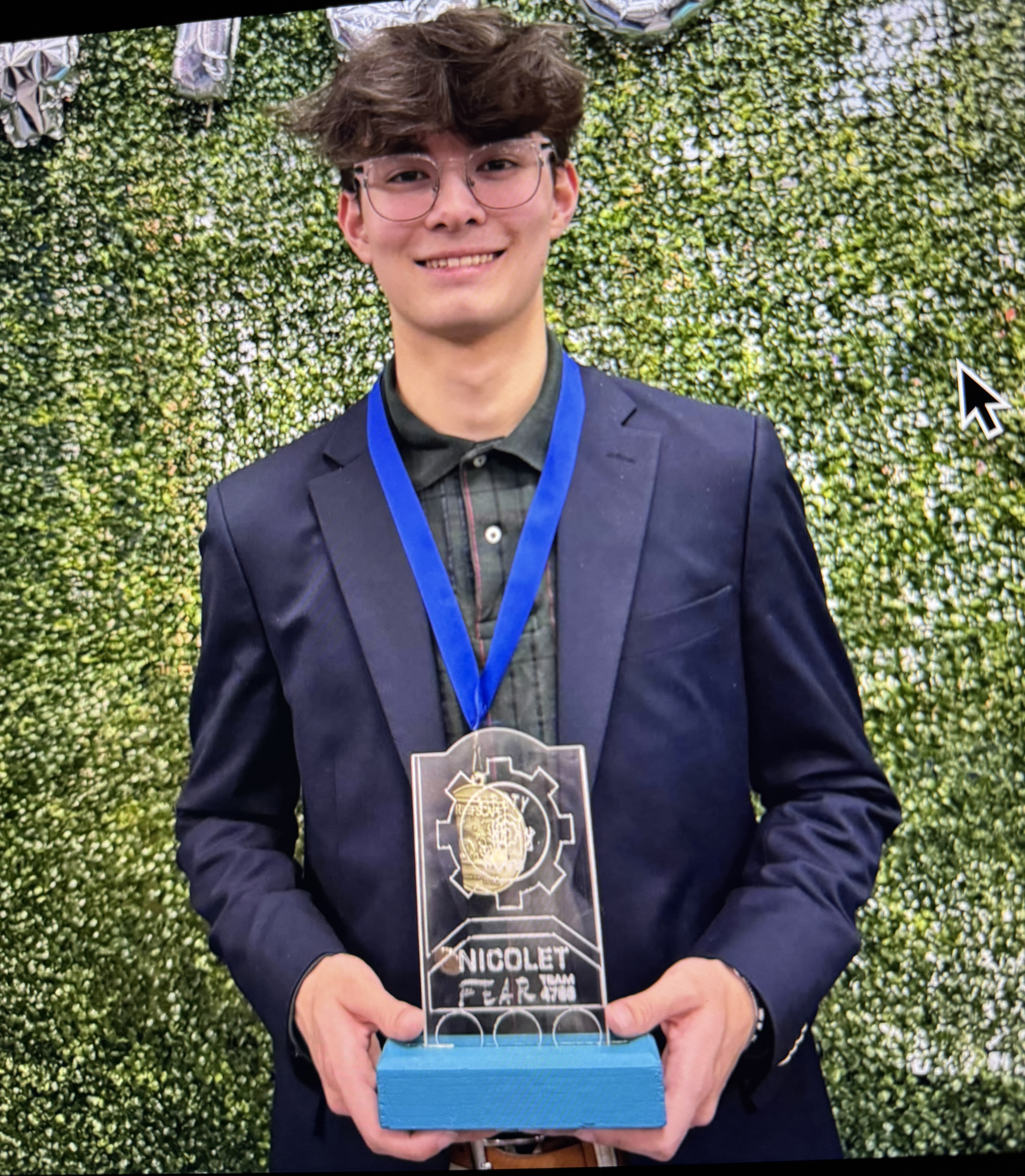
Big days for Peter Charles and his whole family. Anh's FB post:   

"Hard to believe our Peter is about to graduate soon — and even harder to believe he turns 18 in a couple days! From joining his first robotics team in 6th grade to winning his team’s MVP "Firsty” award this year, where his teammates described him as a “master robot builder,” his journey has been nothing short of inspiring. 

He designed a robot that powered his team through another incredible season, and we’ve cheered him on at the World Championships for four years in a row. We've watched him grow into a true leader, and now… he’s headed to the Milwaukee School of Engineering this fall!

Happy (early) birthday, Peter! The future is your's — and we can’t wait to see all that you will continue to build to make the world a better place!"   


I commented:  "I'm so proud of Peter, and of his Dad and Mom for all the support they have provided over many years. The beautiful smiles on all your faces in the photos suggest how very supportive your whole family has been in Peter's long, demanding journey to "Firsty" and 'master robot builder." Bravo!❤❤❤❤ "

Yesterday, I dropped off a birthday card for Peter.  Actually, I gave it to Drew to bring into the hosue  as he got off his school bus.  I included a handwritten letter in which I told him how proud of him I am, and also a check more intended for his use in his first year of college next Fall than simply as a birthday gift.  I'll give him another for his graduation.

I loved the photograph of Andy's family that Anh posted on FB in connection with Peter's "Firstie" award.  I especially loved the proud, happy smile on Andy's face.


Friday, May 2, 2025

5/2/2025

 Friday, May 2, 2025

D+177/103

1929 Billie Holiday (14) and her mother were arrested for prostitution following a raid on a brothel in Harlem, New York City

1938 Thornton Wilder won the  Pulitzer Prize  "Our Town

1949 Arthur Miller won the Pulitzer Prize for "Death of a Salesman"

1978  Sharon Celek Kevil was born

In bed at 9:30, up at 4:20.  43°, high of 52°.   

Prednisone, day 353; 2 mg., day 15/21; Kevzara, day 4/14; CGM, day 15/15; Trulicity, skipped because of pending cataract surgery.  Prednisone at 5:40 a.m.  Other meds at 11:15 a.m.

The image is El Greco's St. Jerome at the Frick between Holbein's Thomas More and Thomas Cromwell.

Food for thought.  From the "2,000 Year Old Virgins" by  S. C. Cornell in The New Yorker, March 12, 2025:

As far as we know, Jesus never said anything about gay sex. He did, however, take a stand on family life: he was opposed. Those who are worthy of Heaven, he says, in Luke 20:35, need not bother with marriage; in fact, per Luke 14:26, the true disciple must “hate” the family he already has. “Everyone who has left houses or brothers or sisters or father or mother or wife or children or fields for my sake,” he declares, in the Gospel of Matthew, “will receive a hundred times as much and will inherit eternal life.” Christianity’s earliest missionaries were also chilly on pair-bonding, in part because they believed that at any moment Jesus would return to whisk his followers off to a heavenly reward many times better than sex. With the rapture so near, who had time for a wife and kids?

Jesus’ failure to return in the first century—what the Oxford historian Diarmaid MacCulloch calls “the first Great Disappointment of many in Christian history”—did not silence the anti-family tendency in Christian thought. As MacCulloch argues in his thrilling and comprehensive new book, “Lower Than the Angels: A History of Sex and Christianity” (Viking), marriage and family have in historical terms come only lately into fashion among Christians. “It is better to marry than to burn,” the apostle Paul famously wrote, but even better was to douse the flames of lust with an analogous but more elevated communion with God, to partake in what MacCulloch calls the “substitute families” of a celibate religious life. Divorce, though generally forbidden, was allowed if a husband wanted to leave marriage for monkhood. In Western Europe, clergy did not regularly perform weddings until the twelfth century, and, as late as the sixteenth century in England, such ceremonies were deemed too lowly to take place in a church’s inner sanctum; they might instead be held outside on the porch, after which newlyweds could enter the church to attend Mass. MacCulloch points out that this approach is much like the compromise that some churches, including the Anglican and Catholic ones, have struck with gay couples today.

For much of Christian history, MacCulloch suggests, all sex was sinful—even the marital and procreative, even the unconscious. (As the Anglican theologian Adrian Thatcher writes in “Vile Bodies: The Body in Christian Teaching, Faith and Practice,” “It is difficult to believe the agony and consternation caused to perfection-seeking monks by wet dreams over the centuries.”) Religious leaders specified days on which, for medical or liturgical reasons, married couples were not to copulate—one Irish rule book from the early seventh century excluded a good two-thirds of the year. Russian Orthodox guides for confessors grouped excessive marital sex with sins such as anal intercourse or prostitution. St. Jerome, a tremendously influential fourth-century commentator known for his Latin translation of the Bible, liked to remind people that “every man who is sexually unrestrained in his interaction with his wife commits adultery with her.” Some Christians, including several notable saints, sought to escape sin entirely through celibate marriages, which, per MacCulloch, “were esteemed and practiced for more than a millennium.”

These early Christians’ opposition to procreation—their nose-thumbing at what has always been the easiest way of spreading a religion—is without question a revolutionary and anti-materialistic stance, and yet it is a good example that what is revolutionary and anti-materialistic is not necessarily conducive to human happiness. If you were a Christian and your spouse died young, as people often did in the fourth century, you might be forbidden sex or parenthood for the rest of your life. The controversy around a widow’s remarriage stemmed partly from a theological analogy in which a woman was meant to serve one husband as the church served one God; under such logic, a second marriage seemed almost polytheistic. But another factor was simply a visceral disgust of sex and family life. MacCulloch quotes a letter from the same Jerome in which he urges a young widow in his circle not to remarry:

You’ve already learned the miseries of marriage. . . . It’s like unwholesome food, and now that you have relieved your heaving stomach of its bile, why should you return to it again, ‘like a dog to its vomit’? . . . Perhaps you are afraid that your noble race will die out, and your father will not have a brat to crawl about his shoulders and smear his neck with filth.

MacCulloch is particularly engaging in his discussion of how baffling the early Christian mortification of the flesh would have seemed to contemporaries. Greco-Roman tradition had long idealized the vigorous, penetrating patriarch, and Jewish custom celebrated those men who had large families and multiple wives. Reversing this hierarchy, Christians held that status among men increased with greater remove from sex. The laity were to be monogamous, the holy men celibate, and the actually divine would not even feel lust. In the Bible, angels had been portrayed as the seducers of mortal women, much like Greek gods. Once Heaven was seen as a place without sex, they were deemed too lofty for such concerns. St. Augustine argued that Jesus did not have erections. 

*************************** 

Was Jesus a 30-year-old Jewish male virgin?  Was he truly a lifelong celibate bachelor?  Says who?  If so, how did that go over in the society in which he lived and in the religion he practiced?  God said unto them, Be fruitful, and multiply, and replenish the earth, and subdue it . . .    Or was Jesus married before he started his 'public ministry?  Did he 'put his wife aside'?  Or, did she die in childbirth, perhaps leading him to his 40 days in the desert?  Who knows?  Was he gay?  What was his relationship with 'the disciple whom he loved'?  (John 13:23; 19:26; 20:2; 21:7, 20) What was his relationship with Mary Magdalene?  Was his mother a "perpetual virgin"?  What about those brothers of his mentioned in the Bible? (Matthew 12:46-50, 13:55-56; Mark 3:31, 6:3; Luke 8:19; John 2:12, 7:3; Acts 1:14; 1 Corinthians 9:5; Galatians 1:19).  What do we really know about the real Jesus and from what sources?  What do we really know about his disciples and the apostles?  The answer, of course, is: very little.  These were people who lived 2,000 years ago.  There are hardly any records of their lives other than those written by people who were already True Believers.  They had, if not dogmas and doctrines to uphold, but wishes, traditions, gossips, 'facts' that would make the 'good news' more cogent, more memorable, more seductive, and the purpose of the writing itself was evangelical, designed to attract converts and reinforce the faith of those already converted.  The writings were tendentious, though for what the writer believed was a good cause.

What were these early believers like?  More specifically, what were their views about sex and about family life?  It seems to me that they were deeply troubled, like many (certainly not all) True Believers today.  I suspect they were deeply troubled by sex and the idea that it is bad.  That's why the 'holiest' persons were ascetic, unmarried, often living apart, undefiled by fucking (to use a pejorative approprite to the subject.)  The denigration of sex and subordination of married life to celibate life has been with us through the Roman Catholic Church ab initio and is still with us.  I really enjoyed the reference by the author of the above book review to the early Christians' baffling "nose-thumbing at what has always been the easiest way of spreading a religion," i.e., having children born into it. 

We are all tattooed in our cradles with the beliefs of our tribe; the record may seem superficial, but it is indelible. You cannot educate a man wholly out of the superstitious fears which were early implanted in his imagination; no matter how utterly his reason may reject them...  Oliver Wendell Holmes, Sr.

I was tattooed in my cradle with Irish Roman Catholicism, and one of the strongest beliefs of that tribe was that SEX IS BAD.  From my memoir:

  “Sex is bad” is another way of saying to boys that girls are bad and to girls that boys are bad.  Lest there be any doubt that, all of its statements to the contrary notwithstanding, the official Church’s position was indeed that sex is bad and women are occasions of sin, here is an illustration of the real attitude about sexuality and women:  “With women of whatever station in life, even if they are related to me or are holy women, I will be particularly cautious, avoiding their familiarity, company or conversation, especially if they are young women.  Nor will I ever fix my eyes on their faces, mindful of what the Holy Spirit teaches us: ‘Do not look intently at a virgin, lest you stumble and incur penalties for her.’ Eccl. 9:5.  So I will never confide in them in any way, but when I have to speak with them I will see that my speech is ‘dry, brief, prudent and correct.”  This is an entry in the journal written during his seminary days by Angelo Roncalli, later John XXIII. 

and
In June of 1950, as I approached my 9th birthday and entering 4th grade, Pius XII canonized the Church’s youngest ‘saint and martyr,’ St. Maria Goretti.  Maria was stabbed to death in 1902 at age 11 years, 9 months, and 21 days, by Alessandro Serenelli, a 20 year old neighbor who attempted to rape her.  She resisted at the cost of her life.  This terrible crime was a cause celèbre in Italy and was picked up by some Church people as evidence of what was wrong with Modernism and Worldliness (Alessandro) and of the value and the primacy of Purity (Maria.)  Maria’s canonization was more significant than most because she was made not only an official saint, but also an official martyr.  “Martyrs” were traditionally those who were killed “for the Faith.”  They were the Christians in the Coliseum, the Vietnamese martyrs, and the like. Alessandro killed Maria not because she was a Catholic or a Christian, but because she refused his sexual advances.  Designating this young victim of murder and attempted rape a martyr carried the message not that sexual assault was evil, a given, but that sex was evil.  It was better for Maria to suffer the fatal penetration of 14 stab wounds than to suffer the unwanted but nonlethal sexual penetration. Maintenance of virginity was exalted over maintenance of life.  The ‘sex is bad’  message was not lost on those of us growing up in the American, which is to say Irish, Catholic Church.  Pictures of St. Maria Goretti joined pictures of St. Therese of Lisieux, the Little Flower who entered the convent at age 14 and died of tuberculosis, a virgin, at age 24, on the walls of St. Leo Grammar School and countless other Catholic schools around the world.

I cannot write of Maria Goretti and Alessandro Serenelli without thinking of my mother and James Hartmann.  My mother suffered slashes rather than deep punctures and Hartmann, unlike Serenelli, had his way with her.  If she had resisted unto death and he had killed her with his knife, as he did with Graclyn Bush, would she have become St. Mary Clausen?  The answer clearly is ‘no,’ because Mary, unlike Maria, was not a virgin.  Mary Clausen, unlike her namesake the BVM, was not a virgin.  Mary Clausen, unlike the primitive church “virgin martyrs,”  was not a virgin.  She was 25, married with two children, and living in the world when she was assaulted, not a child like Maria when she was killed or an adolescent like Therese when she entered the convent.  So my mother, as a woman living in a dangerous and complicated and inhospitable world was hardly a candidate for sainthood in the Church, even if she had died fighting James Hartmann and his knife.  The Church prefers virgins and celibates for sainthood, not moms and dads. 

 ***************************


Thursday, May 1, 2025

5/1/2025

 Thursday, May 1, 2025

D+176/102

1943 Food rationing began in the United States during World War II

1961 Fidel Castro announced there would be no more elections in Cuba

2003 In what became known as the "Mission Accomplished" speech, U.S. President George W. Bush declared that "major combat operations in Iraq have ended" on board the USS Abraham Lincoln off the coast of California

2011 Pope John Paul II was beatified by his successor, Pope Benedict XVI

2020 Armed protesters against stay-at-home-orders gathered at the State Capitol in Lansing, Michigan, as Governor Gretchen Whitmer reinstated the State of Emergency

In bed at 9:30, awake and up at 4:55.  46, high of 53°, 0.05 in. of rain in the last hour, and 1.95 in. expected in the next 24 hours.  

Prednisone, day 252; 2 mg., day 14/21; Kevzara, day 3/14; CGM, day 14/15; Trulicity, 7/7.  Prednisone at 5:05 a.m.  Other meds at 3 p.m. 

I was surprised, almost shocked really, that I went through yesterday without encountering a single mention of the 50th anniversary of the Fall of Saigon.  No videos of Vietnamese people scrambling to get onto Marine helicopters on the roof of the American embassy, or of the helicopter being pushed off a ship into the sea, or of North Vietnamese tanks rumbling through the streets of Saigon.  I am reminded that for most people, the Vietnam War is ancient history.  Ho Chi Minh is known, if at all, more as the name of a city than as the man who led, at least as an icon, the liberation of his country from foreign rulers, including the United States.  The real leaders were Lê Duẩn and the great military general Võ Nguyên Giáp, who defeated the American-supported French at  Dien Bien Phu in 1954, and the Americans from 1965 till 1973.  Most Americans have never heard of these men, nor probably of Robert McNamara or William Westmoreland.  Certainly, they have never heard of the men who advised Lyndon Baines Johnson to get out of Vietnam.  In his 1964 presidential campaign, when I was a 23-year-old Marine lieutenant, Johnson promised the American people, “We are not about to send American boys nine or 10,000 miles away from their homes to do what Asian boys ought to be doing for themselves.”  But of course, he did just that, despite prescient warnings against it.     On July 23, 1965, when I had been in Vietnam for only 2 weeks, Johnson met with his top advisors about the deteriorating situation in Vietnam.  The Marines had been sent in only to protect the airbase at Danang.  A decision had to be made about full-scale escalation of the war, i.e., to go on the offensive against the VC and North Vietnnam.   Administration hawks, led by Defense Secretary Robert McNamara, urged Johnson to give the public all the facts, ask Congress to raise taxes, mobilize the reserves, and declare a national emergency. But George Ball, the undersecretary of state, urged LBJ to stage a “tactical withdrawal” to avert a catastrophe. He warned that draftees were ill-suited to fight a jungle war; that backing for the war would implode as casualties rose, and that, in the end, the United States would lose.  He was right.  


From my memoir:

When I arrived in Vietnam in July, 1965, the conflict there was not yet a full-fledged American war.  The mission of American combat forces was limited and essentially defensive.  It all changed two weeks after my arrival when President Johnson made the decision to grant General Westmoreland’s request for a massive infusion of American forces in 1965 and more in 1966. He granted the request for the very reasons that should have caused him to deny it - because he knew that the South Vietnamese government was incapable of effectively governing the country and the South Vietnamese military was incapable of defending it.  That decision on that date for those reasons turned the war into an American war.  The whole world knew of the fecklessness and corruption of the Vietnamese government in Saigon and of the powerlessness of the South Vietnamese military and of the determination of the VC/NVA forces and we Marines knew it too.  In Robert McNamara’s In Retrospect, he acknowledges the mistake of not pulling out of Vietnam early.  He wrote:


By [the early or mid 1960s] it should have become apparent that the two conditions underlying President Kennedy’s decision to send military advisors to South Vietnam were not being met and, indeed, could not be met: political stability did not exist and was unlikely ever to be achieved; and the South Vietnamese, even with our training assistance and logistical support, were incapable of defending themselves.


Given these facts – and they are facts – I believe we could and should have withdrawn from South Vietnam either in late 1963 amid the turmoil following Điem’s assassination or in late 1964 or early 1965 in the face of increasing political and military weakness in South Vietnam.  And, as the table opposite suggests, there were at least three other occasions when withdrawal could have been justified.


Date of Withdrawal

US Forces 

US Killed 

Basis for Withdrawal

Nov. 1963

16,300 advisors

78

Collapse of  Điem regime and political instability

Late 1964 or

Early 1965

23,300

advisors

225

Clear indication of SVN’s inability to defend itself, even with US training and logistical support

July, 1965

81,400 troops

509

Further evidence of the above

December, 1965

184,300 troops

1,594

Evidence the US military tactics and training were inappropriate for guerrilla war being waged.

December, 1967

485,600 troops

15,979

CIA reports indicating bombing in the North would not force North Vietnam to desist is the face of our inability to turn back enemy forces in South Vietnam.

January, 1973

543,400 troops (April, 1969)

58,191

Signing of Paris Accords, marking end of US military involvement


            All of my college roommates, except Joe Daley, would end up serving in Vietnam.  Tom Devitt served as Executive Officer, one step below the commanding officer, of a Marine artillery battery.  The man he replaced had been ‘fragged’, killed by his own men with a fragmentation grenade thrown into his tent.  Gerry Nugent served as a Marine infantry officer.  Ed Felsenthal and Bill Hendricks served aboard ships on the South China Sea, pulling into the port of Da Nang frequently.  None of us was in contact with any of the others during our time ‘in country.’  One of our friends from the NROTC unit at Marquette, Jay Tremblay, was shot down and lost piloting his aircraft over North Vietnam.  Another good friend, John Boyan, flew H34 helicopters for 13 months in Marine operations.  Pat Townsend, Dick Coffman, Brian Fagin, all good friends from Marquette, all served as Marines in Vietnam and made it home in one piece.


 . . . .  I left Vietnam wondering “what was that all about?”  “What’s going to come of all this?”  I would have preferred to be going to Japan rather than Okinawa, but I was happy just to be getting out of the Alice in Wonderland, Catch-22 world of Vietnam.  I was 24 years, 6 months and 4 days old when I departed Vietnam; my father had been 24 years, 6 months, and 8 days old when he departed Iwo Jima.   I aged more than 8 months during my 8 months in Vietnam, but not nearly as much as my father aged during his one month on Iwo Jima.  Semper Fi.


Walt Whitman, With Antecedents, 1860

I assert that all past days were what they must have been,

And what they could no-how have been better than they were,

And that to-day is what it must be, and that America is,

And that to-day and America could no-how be better than they are.   

 VA Eye Clinic.    I went in for my regular check-up, which went fine, and got scheduled for cataract surgery next Friday.  I'm keeping my fingers crossed that I might be able to read again.  As is usually the case, I felt better leaving the VA than I did going in, not because I wanted to get outta there, but because I was treated so well in there and was uplifted by seeing all the other veterans gathered there.  My medtech, Fran, helped another and older veteran before me, a fellow in a wheelchair, with no legs, and what looked like a surgical bandage adhered to the middle of his scalp.  She couldn't have been more caring, compassionate, and courteous to him or to me.  I deeply hope that the good spirit that is so present at this great medical facility isn't crushed by Trump, DOGE, and Trump's Baptist minister who is running the VA now.  Fingers crossed.